

Saving Tracker Template: Simple Tools for Financial Goals
Hey folks, it's Ren here. There is a doorframe in my parents' house with pencil marks all up it.
Little lines, dates next to them, going back years. You never see a child grow day to day, it is far too slow. But those marks? They are proof. Undeniable, a bit emotional, and weirdly motivating to keep going.
A saving tracker is the doorframe for your money. Day to day, savings grow too slowly to feel. The tracker is the pencil mark that proves it is happening.
"Little by little, a little becomes a lot." — Tanzanian proverb
🔍 Why saving without tracking quietly stalls
Saving is slow by nature, and slow things are easy to lose faith in. Without a tracker, here is what tends to happen, and none of it is a willpower failure:
- Progress is invisible, so there is no reward loop to keep you going.
- One vague savings pot is easy to dip into, because nothing in it has a clear job.
- You cannot tell if you are on pace, so a goal stays a hope rather than a plan.
- A slow month feels like failure instead of just a slow month.
A saving tracker turns all of that into pencil marks on the doorframe, small, visible, and proof that it is working.

✅ What a good saving tracker includes
A useful saving tracker is simple. For each goal it holds the name, the target amount, the date you are aiming for, the running balance, and a progress bar or percentage. That is the whole foundation. The progress bar is not decoration, it is the engine, because a visible mark is what makes you want to add the next one.
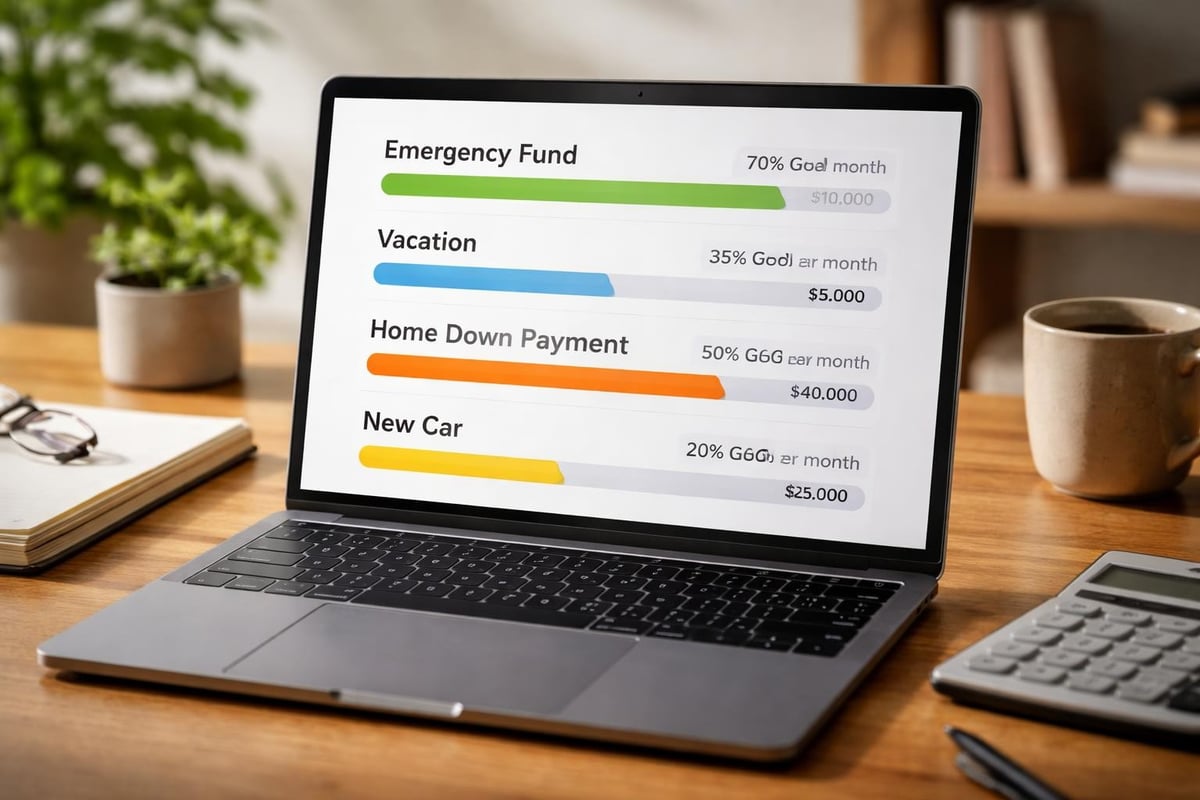
Setting it up
- List every goal, and give each one its own line. An emergency fund and a holiday fund are different jobs and should not share a pot.
- Add the target and the date. This is what lets the tracker tell you whether you are on pace. If you only know one of them, our free savings goal calculator works out the other.
- Log every contribution, the same day you make it, while the small hit of satisfaction is fresh.
- Mark the milestones. Every 25% is worth a tiny, free celebration. The doorframe only works if you look at it.

🚫 Saving tracker mistakes to sidestep
- One mixed-up savings pot. Fix it: separate goals, separate lines. Clarity stops you raiding it.
- Updating it only occasionally. Fix it: log contributions the day you make them, so the pace stays honest.
- No date on the goal. Fix it: a target without a deadline cannot tell you if you are on track.
- Ignoring the slow months. Fix it: log them anyway. A flat patch on the doorframe is still part of the story.

Want the tracker already built?
You can build your own, and the steps above are the whole method. But if you would rather skip the setup, the Ultimate Budget System has multi-goal saving tracking with balances, dates and progress bars built in, sitting right alongside your full budget. Set it up once and it runs the year. Trusted by over 70,000 customers.
Get the Ultimate Budget System →🎯 Your action steps this week
- List every savings goal and give each one its own line.
- Add a target amount and a real date to each.
- Record your current balance as the starting mark.
- Log your next contribution the day you make it.
- Set milestone markers at 25, 50 and 75%. To set the contribution amounts properly, pair this with our savings planner guide.
A saving tracker does not make you save faster. It just makes the slow, quiet progress visible, and visible progress is the thing that keeps you adding marks to the doorframe.
❓ Frequently asked questions
What is a saving tracker?
It is a simple tool that records each savings goal with its target, date, running balance and a progress bar, so your slow, day-to-day progress becomes something you can actually see.
How is a saving tracker different from a savings planner?
A planner works out how much to save and by when. A tracker records and shows the progress as it happens. The best tools do both together.
How often should I update it?
Log each contribution the day you make it. It takes seconds and keeps both the numbers and your motivation accurate.
Should each goal be separate?
Yes. Separate lines for separate goals stops your savings blurring into one pot that is easy to dip into without noticing.
You have got this. One pencil mark, one contribution at a time.
To your financial freedom,
Ren
About Ren
Ren is the founder of JRen Digital, home to minimalist budgeting and debt spreadsheets trusted by over 70,000 customers worldwide. Ren writes practical, no-nonsense guides that help everyday people take the stress out of money. Explore the full range of templates at jrendigital.com.
Keep reading
This article is for general information only and is not financial advice. It does not take into account your personal situation, needs or objectives. Please consider speaking with a qualified financial adviser before making financial decisions.