

Paycheck Budget Planner: Master Your Money in 2026
Hey folks, it's Ren here. For years I tried to run my money on a monthly calendar.
The trouble was, I did not get paid monthly. I got paid fortnightly. So every month I was trying to squeeze a real, lumpy pay rhythm into a tidy calendar box that was not mine. It was like wearing shoes half a size too small, you can walk in them, but something always pinches.
A paycheck budget planner takes the shoes off. Instead of budgeting by the calendar, you budget by when money actually lands in your account. Suddenly the plan fits.
"It's not how much money you make, but how much you keep." — Robert Kiyosaki
🔍 Why monthly budgets pinch
Your bills do not wait for a convenient monthly schedule. Rent lands on the 1st, utilities on the 15th, the car payment on the 22nd. When your pay arrives on different dates again, a single monthly overview just does not give you the clarity to avoid the gap between "bill is due" and "money is here."
Paycheck budgeting fixes that by assigning specific bills to specific paychecks. The benefits are immediate, and none of this means you are bad with money, it just means the old method never matched your reality:
- No more timing gaps between when bills are due and when funds arrive.
- Far less leaning on credit cards or overdraft to bridge the wait.
- Crystal-clear discretionary spending for each pay period.
- Natural checkpoints, every payday, to review how you are going.
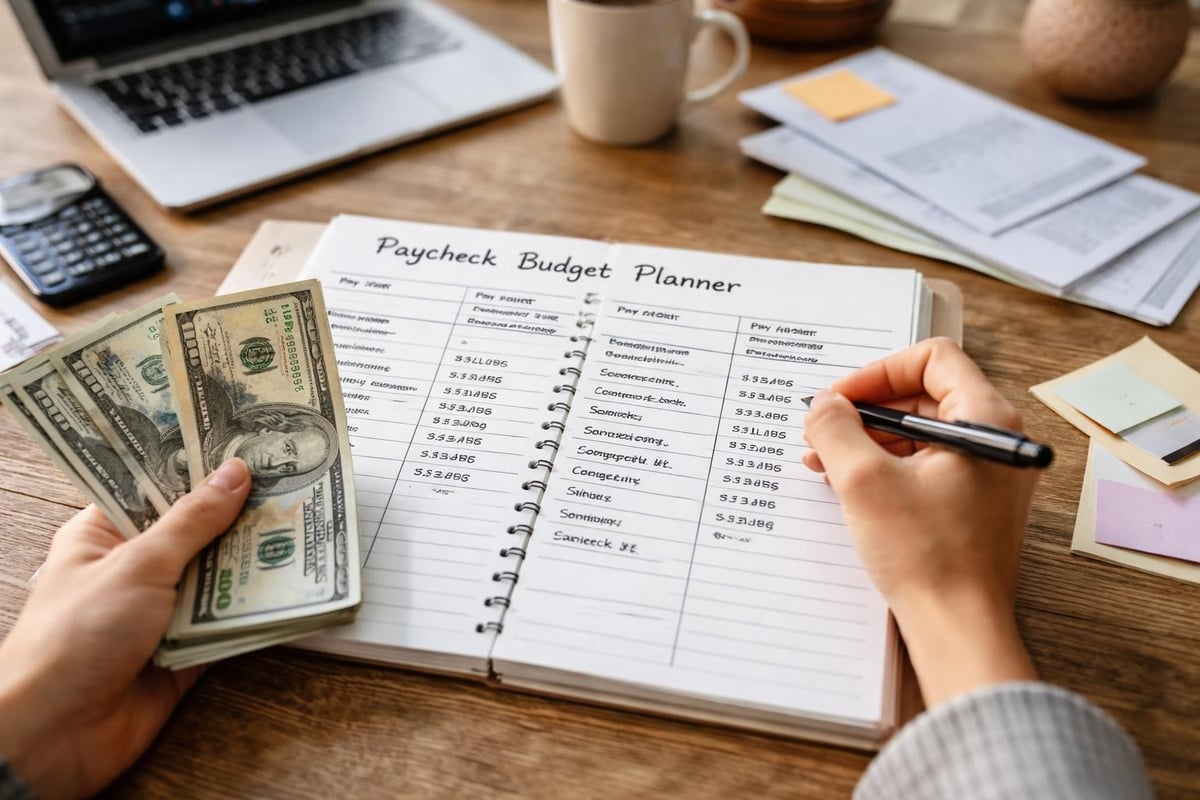
✅ Setting up your paycheck budget planner
- Map your pay schedule. Write down your exact pay dates for the next three months. If you are paid fortnightly, note the two months a year with a third paycheck, those are gold.
- List every income source. Main job plus any side income. For variable income, use a conservative estimate based on your lowest recent earnings.
- Catalogue every bill with its due date. Name, date, amount, and whether it is fixed or variable.
- Assign each bill to the paycheck before its due date. This is the heart of it. A bill due on the 8th goes to the paycheck that lands before the 8th, even if that makes one pay period heavier. The goal is security, not perfect balance.
- Allocate what is left. Once fixed bills are covered, spread the rest across groceries, transport, personal care and a little discretionary spending.
The one-paycheck-ahead trick
New paycheck budgeters often hit a wall: bills due in the first few days of the month, before that month's first paycheck arrives. The fix is a single transition: use your last paycheck of the previous month to cover early-month bills. You budget one paycheck ahead from then on, and the timing gap closes permanently.
🌊 Working with variable income
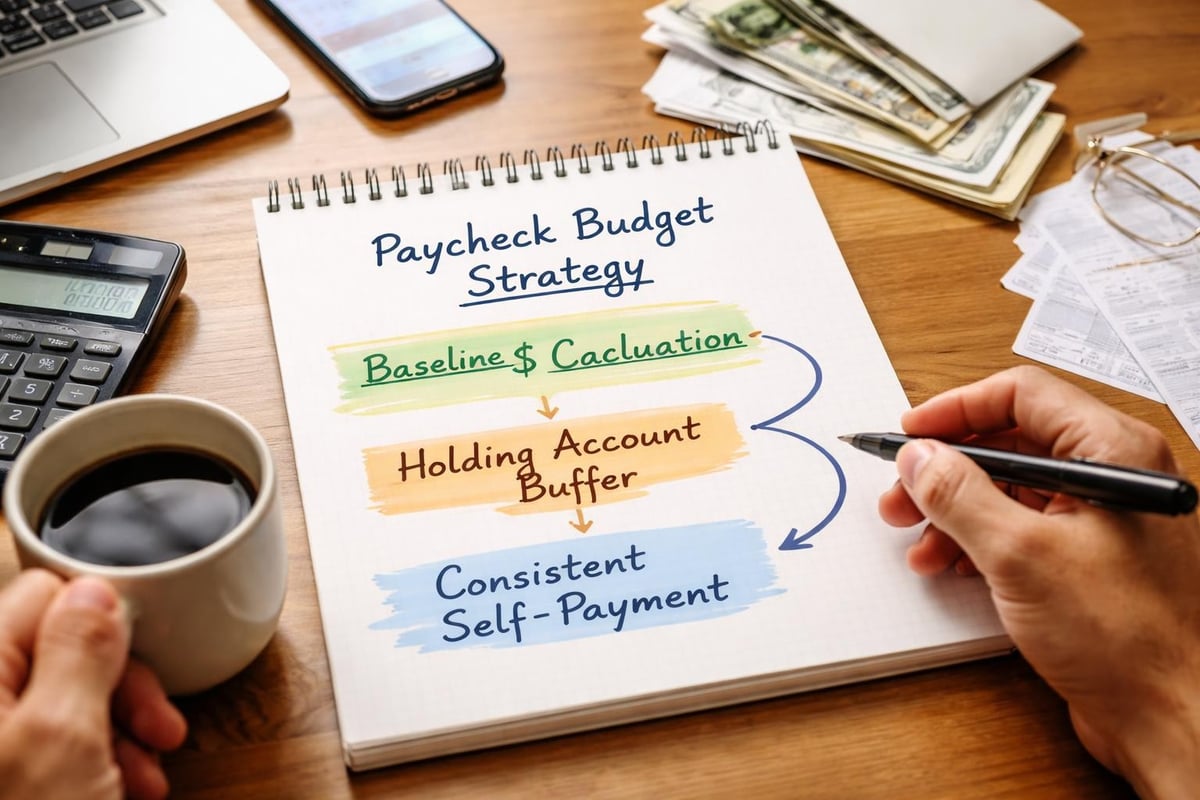
Freelancers and commission earners need one small tweak. Work out your average income over the last six to twelve months, then budget on your lowest month, not the average. When a bigger paycheck arrives, the surplus goes to a specific job, emergency fund, extra debt payment, sinking funds, rather than quietly inflating your lifestyle. Even better, run a holding account: every payment lands there, and you pay yourself a steady "paycheck" from it on set dates, which smooths the lumps right out.
🚫 Common paycheck budgeting snags
- Irregular expenses breaking the plan. Fix it: divide each annual cost by your number of paychecks and set that aside from every one. The money is waiting when the bill lands.
- Three-paycheck months disappearing. Fix it: assign that third paycheck a job before it arrives, savings, debt, or annual costs, so it does not just evaporate into spending.
- Drifting between paydays. Fix it: a quick mid-period check on your variable categories catches overspending while there is still time to adjust.
- Making it too complicated. Fix it: a simple system you update beats a sophisticated one you abandon. Every time.

Want a planner built for paydays?
You can build your own, and the steps above are the whole method. But if you want it ready to go, Paycheck Budget 2.0 is designed around your pay cycle, with bills assigned to paychecks, clear per-period spending, and room for sinking funds and savings. No calendar-shaped shoes that pinch. Trusted by over 70,000 customers.
Get Paycheck Budget 2.0 →🎯 Your action steps this week
- Write down your exact pay dates for the next three months.
- Catalogue every bill with its due date and amount.
- Assign each bill to the paycheck that lands before it is due.
- Set aside a slice of every paycheck for irregular annual costs.
- Give any third paycheck a job in advance. For the wider tracking picture, pair this with our budget tracker spreadsheet guide.
Taking control of your money starts with a system that matches how you actually get paid. Once the plan fits your real rhythm, the month-end panic just quietly stops happening.
❓ Frequently asked questions
What is a paycheck budget planner?
It is a budgeting method, and the spreadsheet that runs it, where you organise your spending around when your pay actually arrives instead of around the calendar month, assigning specific bills to specific paychecks.
How is it different from a monthly budget?
A monthly budget looks at the whole month at once. A paycheck planner breaks it into pay-period chunks, so you always know exactly what money is available right now and what it is already promised to.
Does paycheck budgeting work if I am paid fortnightly?
Especially well. Fortnightly pay gives you two three-paycheck months a year, and a paycheck planner helps you spot them and put that extra money straight to work.
What about irregular or freelance income?
Budget on your lowest recent month as a baseline, and consider a holding account you pay yourself a steady amount from. Surplus from bigger months goes to savings, debt or sinking funds.
You have got this. One paycheck, one clear plan, one calm payday at a time.
To your financial freedom,
Ren
About Ren
Ren is the founder of JRen Digital, home to minimalist budgeting and debt spreadsheets trusted by over 70,000 customers worldwide. Ren writes practical, no-nonsense guides that help everyday people take the stress out of money. Explore the full range of templates at jrendigital.com.
Keep reading
- Paycheck Budget: Take Control Before Your Money Vanishes
- Paycheck Planner Template: Plan Every Dollar Before Payday
- Maximize Your Paycheck with This Budgeting Template
- Budget Template That Actually Works in 2026
- Biweekly Budget Spreadsheet: Bills to Paychecks
- Budget for Irregular Income: The Baseline Method
- Budgeting for Two Paychecks a Month (Made Simple)
- Single Income Budget Spreadsheet for One Wage
- Income Tracker Spreadsheet: Budget on the Average
This article is for general information only and is not financial advice. It does not take into account your personal situation, needs or objectives. Please consider speaking with a qualified financial adviser before making financial decisions.