

Debt Planner: Pay Off Debt Faster in 2026
Hey folks, it's Ren here. Let me start with my pasta.
I have one recipe I can make with my eyes closed. It is not because I am a brilliant cook, I am very much not. It is because I have made it so many times that the steps are just there: these ingredients, in this order, every time. No stress, no guessing, and it turns out well even on a chaotic Tuesday night.
A debt planner is the recipe version of paying off debt. You gather your ingredients, you follow a method, and you stop having to summon willpower from nowhere every month. The plan does the remembering for you.
"You can't manage what you don't measure." — Peter Drucker
🔍 Why paying minimums forever feels like treading water
Here is the honest bit, and please be gentle with yourself about it: most people are not stuck on debt because they are careless. They are stuck because they are flying blind. No single total, no chosen strategy, no way to see whether this month actually moved the needle.
Without a planner, this is usually what is going on:
- You cannot say your total debt out loud, so it feels bigger and vaguer than it is.
- Interest quietly eats most of each payment, and you never see how much.
- There is no payoff date, so there is no finish line to walk towards.
- You are paying whatever feels right, instead of following a method that is proven to work.
A debt planner swaps all of that anxiety for a recipe card. Same ingredients, same method, every month.

⚖️ The two methods worth your time
When you set up your planner, you choose one of two proven payoff methods. The snowball has you clear your smallest balance first, for a quick win and momentum. The avalanche has you attack your highest interest rate first, which saves the most money overall.
The avalanche wins on a calculator. The snowball wins in real kitchens, real lives, because the method you actually stick with beats the one that is mathematically perfect but abandoned by autumn. Pick the one that matches how you are wired, not the one a finance guru insists on.
✅ Setting up your debt planner
- Gather your ingredients. For every debt: the current balance, the interest rate, the minimum payment and the due date. All of them, including money owed to family.
- Total it up. Add the balances. It might sting. It also turns a fog into a number you can actually work with.
- Choose your method. Snowball or avalanche. Just commit to one for now.
- Set your extra payment. The realistic amount you can add on top of minimums every month, even a tight one. Even $50 changes the date.
- Read your payoff date. A good planner shows you when the last debt clears, and rolls each cleared payment onto the next debt automatically.
Most people discover they had been underestimating their total, or did not realise which card was quietly costing them the most. That is not a bad moment. That is the moment the recipe starts working.
Where the extra money comes from
You do not need a pay rise. You need to redirect money you are already spending: a forgotten subscription, a couple of packed lunches, one bill you negotiate down, one impulse buy you sleep on. For a lot of people that quietly adds up to a few hundred dollars a month, and your planner shows you exactly how many months each extra dollar shaves off.
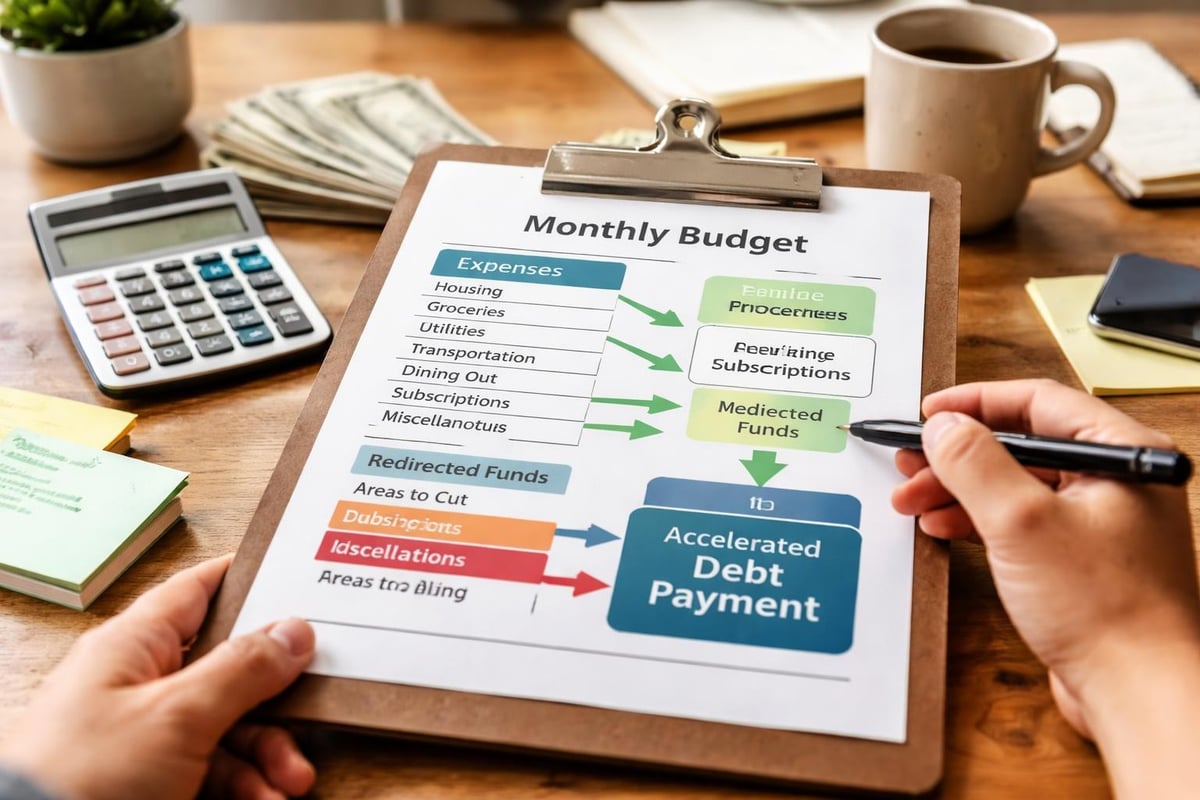
Here is what that looks like with real numbers. Say you owe $3,200 on a card at 18.99%, $5,800 on another at 15.24%, and $12,400 on a car loan at 4.5%. That is $21,400, with minimums around $520 a month. Pay only the minimums and you are in debt for years. Add just $200 extra a month on the avalanche method and you are done in roughly three and a half years, saving over $4,000 in interest. Your planner does that maths for you, no wondering required.

Want the recipe already written?
You can build your own planner, and the steps above are the whole method. But if you would rather start tonight, the Complete Debt Payoff Planner has snowball and avalanche options, automatic payoff dates and progress tracking ready to go. Trusted by over 70,000 customers, no subscription, yours forever.
Get the Debt Payoff Planner →🚫 Debt planner mistakes to sidestep
- Not updating it monthly. Fix it: block ten minutes with your coffee on the same day each month. The planner only works on current numbers.
- Ignoring rate changes. Fix it: check your card rates each quarter. If one jumps, your order might need to shift.
- Quitting when life gets messy. Fix it: a surprise expense is not a failure. Re-enter the numbers and carry on. That is literally what the planner is for.
- Forgetting the middle is the hard part. Fix it: track percentage paid and your debt-free date so the slow months still feel like progress.

🎯 Your action steps this week
- Gather every debt with its balance, rate, minimum payment and due date.
- Total it up and pick your method, snowball or avalanche.
- Find $100 to $300 you can redirect from spending you will not miss.
- Set your extra payment and note your projected debt-free date.
- Pair it with a simple budget. If you have not got the spending side sorted yet, start with our guide to paying off debt fast.
Debt does not have to run your life. With a clear recipe, a method that suits you, and ten honest minutes a month, the finish line is closer than it feels right now.
Or, even easier, skip the manual maths and run your numbers through our free debt snowball and avalanche calculator to see your debt-free date in seconds.
❓ Frequently asked questions
What is a debt planner?
A debt planner is a simple system, usually a spreadsheet, that lists every debt, applies a payoff strategy, and shows you a projected debt-free date. Change a payment and the date updates, so every decision becomes visible.
Is a debt planner different from a budget?
Yes, and they work best together. A budget shows how much money you have and how much you can free up. A debt planner tells you where to send it for the fastest payoff.
How often should I update my debt planner?
Once a month is plenty, ideally the same day each month. Ten minutes keeps the numbers honest and the payoff date accurate.
Snowball or avalanche in a debt planner?
Avalanche saves the most interest. Snowball gives faster visible wins and keeps most people motivated. A good planner shows both so you can choose with your eyes open.
You have got this. One recipe, one month, one cleared balance at a time.
To your financial freedom,
Ren
About Ren
Ren is the founder of JRen Digital, home to minimalist budgeting and debt spreadsheets trusted by over 70,000 customers worldwide. Ren writes practical, no-nonsense guides that help everyday people take the stress out of money. Explore the full range of templates at jrendigital.com.
Keep reading
This article is for general information only and is not financial advice. It does not take into account your personal situation, needs or objectives. Please consider speaking with a qualified financial adviser before making financial decisions.